
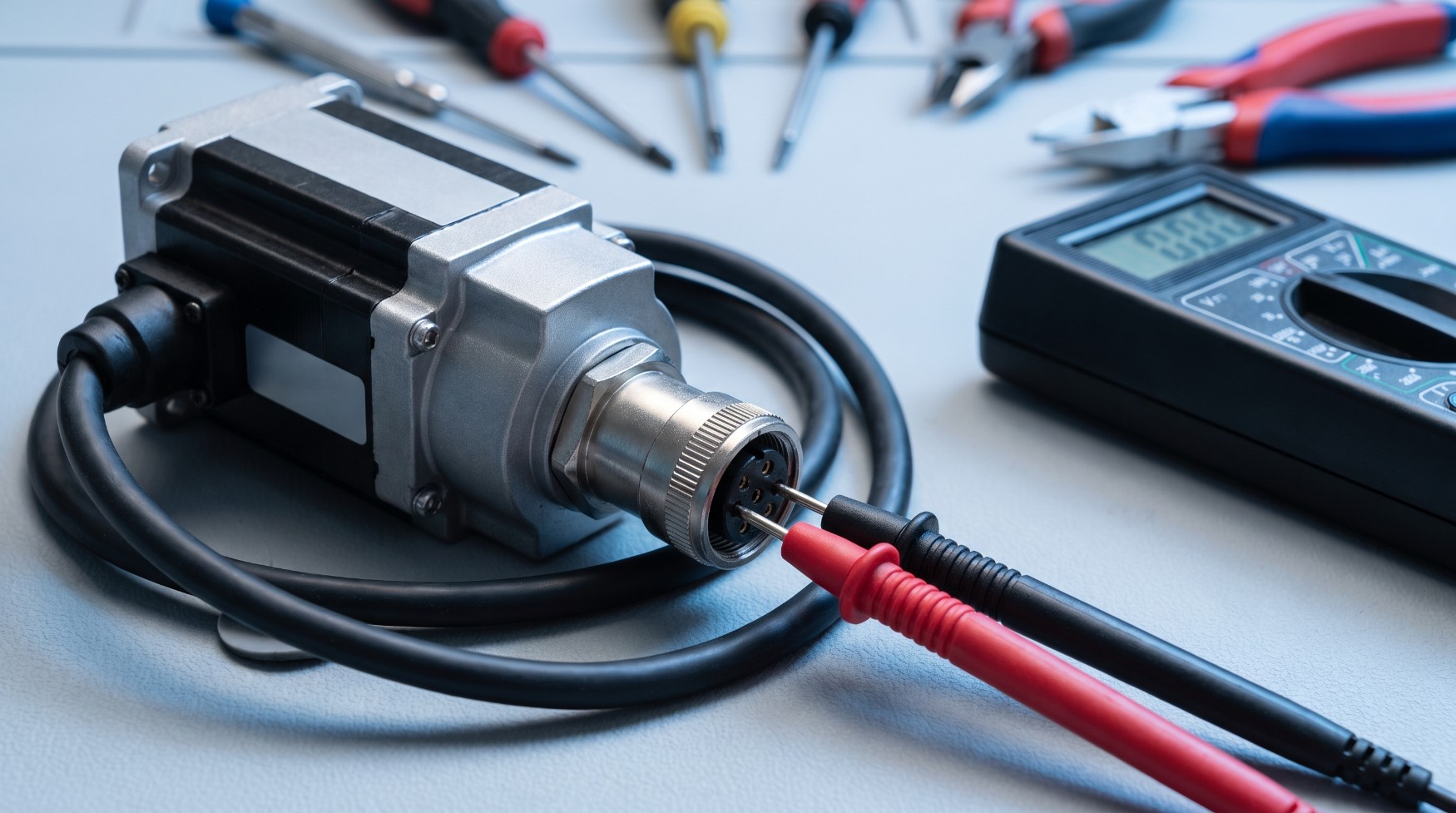
When a servo-driven axis starts faulting, positioning erratically, or refusing to move, the motor is the obvious suspect—but it isn't always the guilty one. Before you pull a servo and send it out (or worse, replace a healthy motor), a handful of straightforward tests will tell you whether the motor is actually the problem or whether the fault lives in the drive, the cabling, or the feedback path.
Here's how to test a servo motor properly, what each result is telling you, and the warning signs that one is on its way out.
Servo motors usually warn you before they quit. Watch for:
Any one of these is a reason to test. Several together usually means the motor is the cause.
Servo motors demand respect before you touch them:
You can complete a solid servo test with three instruments:
You'll also want the motor's nameplate data and, ideally, a servo motor windings diagram or datasheet so you know the expected phase configuration and resistance values for your specific model.
Most industrial servos are three-phase AC (brushless) motors with windings labeled U, V, and W. The tests below apply to that common type.
Start simple. Inspect the cables, connectors, and motor body for damage, moisture, or burnt spots. Then—with power removed—rotate the shaft by hand. It should turn smoothly with light, even resistance. Roughness, grinding, or play indicates worn bearings.
Set your multimeter to the low-ohms range and measure phase-to-phase resistance across each pair of windings: U–V, V–W, and W–U. On a healthy motor, all three readings should be very close to each other and match the manufacturer's spec.
An imbalance between the three phases is one of the clearest indicators of internal winding damage—this is exactly why the windings diagram matters, so you're comparing against the right expected values.
Using the megohmmeter (typically at 500V for these motors), measure from each motor phase to the motor frame/ground. You're checking whether the winding insulation is still isolating the windings from the chassis.
With the motor disconnected from the drive, set your multimeter to AC volts and spin the shaft by hand at a steady rate (or with a drill, carefully). Measure the voltage generated across each phase pair. A healthy motor produces balanced AC voltage across all three; a large imbalance points again to a winding fault.
If the windings test clean but the axis still misbehaves, the encoder or resolver is the prime suspect. Verify its wiring and connector first, then—if you have an oscilloscope and the signal specs—confirm it's producing clean, correctly-phased feedback. Many "motor" faults are really feedback faults.
Put the picture together:
A motor with worn bearings or a failed encoder is very often worth repairing rather than replacing, especially for higher-end or discontinued servos where a new unit carries a long lead time and a steep price. Winding faults and insulation breakdown are more involved but still frequently repairable by a shop with the right equipment.
The catch is that a proper diagnosis—and a genuine repair-vs-replace answer—usually needs load testing and calibration equipment beyond a field multimeter. If your tests point to a motor fault, or if they come back clean but the axis still won't behave, a specialist can bench-test the motor under load and confirm the root cause before you spend money on the wrong part.
IVS Incorporated repairs, rebuilds, and load-tests servo motors across all major brands, including obsolete models, with full functional testing before return. If you've got a servo that's failing your tests—or one you can't quite pin down—see our motor repair services, and if the fault turns out to sit in the drive, we handle drive repair as well.
Lorem ipsum dolor sit amet, consectetur adipiscing elit. Suspendisse varius enim in eros elementum tristique.

Lorem ipsum dolor sit amet, consectetur adipiscing elit. Suspendisse varius enim in eros elementum tristique.
Lorem ipsum dolor sit amet, consectetur adipiscing elit. Suspendisse varius enim in eros elementum tristique.

Lorem ipsum dolor sit amet, consectetur adipiscing elit. Suspendisse varius enim in eros elementum tristique. Duis cursus, mi quis viverra ornare, eros dolor interdum nulla, ut commodo diam libero vitae erat. Aenean faucibus nibh et justo cursus id rutrum lorem imperdiet. Nunc ut sem vitae risus tristique posuere.
Lorem ipsum dolor sit amet, consectetur adipiscing elit. Suspendisse varius enim in eros elementum tristique. Duis cursus, mi quis viverra ornare, eros dolor interdum nulla, ut commodo diam libero vitae erat. Aenean faucibus nibh et justo cursus id rutrum lorem imperdiet. Nunc ut sem vitae risus tristique posuere.
Lorem ipsum dolor sit amet, consectetur adipiscing elit. Suspendisse varius enim in eros elementum tristique. Duis cursus, mi quis viverra ornare, eros dolor interdum nulla, ut commodo diam libero vitae erat. Aenean faucibus nibh et justo cursus id rutrum lorem imperdiet. Nunc ut sem vitae risus tristique posuere.


Ready to get started? Contact us.
Whether you need a repair/service or have a question, please feel free to send us a message using the form below.