
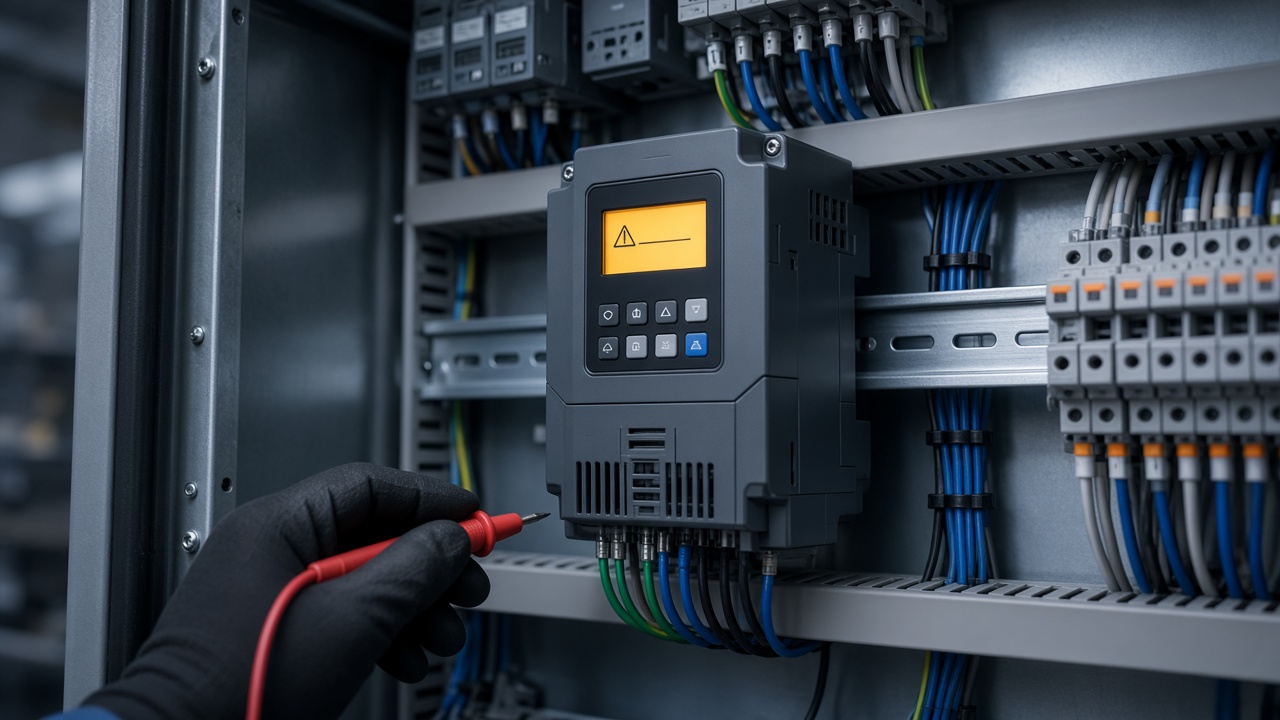
A variable frequency drive trips, the motor coasts to a stop, and the display shows a code. That code is the drive telling you what it saw in the last few milliseconds before it protected itself. Read it correctly and you will usually find the problem is outside the drive. Here is how to work through the common VFD fault codes in order, and how to know when the drive itself needs repair.
Every VFD manufacturer uses its own code numbers, but the underlying faults are the same across Allen-Bradley PowerFlex, Siemens SINAMICS, ABB, Yaskawa, Danfoss, Schneider and the rest. The drive monitors DC bus voltage, output current, heatsink temperature and a handful of internal signals, and trips when one leaves its window.
Before you touch anything:
An overcurrent fault means output current spiked past the drive's limit. It is the most common VFD fault code and the one most often blamed on the drive when the drive is fine.
Check, in order:
If the drive trips OC with the motor leads disconnected, the output transistors (IGBTs) or current sensors are suspect and the drive needs bench repair.
Overvoltage is almost always a DC bus problem, and the DC bus rises for two reasons:
Undervoltage means the bus sagged. Look for:
The drive's heatsink or internal ambient exceeded its limit. This is a slow-moving fault, so the cause is usually visible:
The drive detected current leaking to ground. Lock out and megger the motor and the motor cable separately. Long cable runs with high carrier frequency can also produce enough capacitive leakage to trip sensitive drives; an output reactor or dV/dt filter solves it. If the motor and cable test clean and the fault persists with leads disconnected, the fault is in the drive's output section.
The drive calculated that the motor has been drawing more than rated current for too long. Verify the motor nameplate data in the drive, then look at the mechanical load and the duty cycle. A motor that is now too small for a process that has grown over the years will trip OL honestly. If the motor itself is hot and drawing high current with no mechanical cause, it may need rewinding; see our motor repair services.
Fieldbus timeouts, lost run-enable signals and external fault inputs are wiring and network problems far more often than drive problems. Check the control wiring, terminal torque, shield grounding and the PLC side of the link. The PLC troubleshooting field guide covers the controller end.
After the checks above, these symptoms point to the drive hardware:
A drive in this condition is repairable far more often than it is scrap. Power sections, IGBT modules, bus capacitors, gate driver boards, control boards, cooling fans and current sensors are all replaceable at the component level. For larger or discontinued drives, repair is usually the faster and less expensive path, and it avoids re-engineering parameters and wiring for a different model.
IVS Incorporated repairs variable frequency drives, DC drives and servo drives from Allen-Bradley, Siemens, ABB, Yaskawa, Danfoss and other manufacturers at our Plymouth, Michigan facility. Every drive is diagnosed at the component level and tested under load before it ships back. If your drive is throwing a code you cannot clear, send us the model and the fault history and we will tell you whether it is a panel problem or a drive problem. See our drive repair services or request a quote.
Overcurrent. It is also the one most often caused by something other than the drive: a short acceleration ramp, a mechanical overload or a motor insulation fault.
Once, to see whether it was a transient. If the fault returns, stop and diagnose. Repeated resets on an overcurrent or ground fault can destroy the output transistors.
Disconnect the motor leads and run the drive. If it faults with no load connected, suspect the drive. If it runs clean, megger the motor and cable.
For most drives above a small horsepower range, and for any discontinued model, yes. Component-level repair restores the exact unit, so parameters and wiring stay the same.
It depends mostly on heat and cleanliness. Cooling fans and bus capacitors are the wear items; replacing them on a schedule extends drive life considerably.
Lorem ipsum dolor sit amet, consectetur adipiscing elit. Suspendisse varius enim in eros elementum tristique.

Lorem ipsum dolor sit amet, consectetur adipiscing elit. Suspendisse varius enim in eros elementum tristique.
Lorem ipsum dolor sit amet, consectetur adipiscing elit. Suspendisse varius enim in eros elementum tristique.

Lorem ipsum dolor sit amet, consectetur adipiscing elit. Suspendisse varius enim in eros elementum tristique. Duis cursus, mi quis viverra ornare, eros dolor interdum nulla, ut commodo diam libero vitae erat. Aenean faucibus nibh et justo cursus id rutrum lorem imperdiet. Nunc ut sem vitae risus tristique posuere.
Lorem ipsum dolor sit amet, consectetur adipiscing elit. Suspendisse varius enim in eros elementum tristique. Duis cursus, mi quis viverra ornare, eros dolor interdum nulla, ut commodo diam libero vitae erat. Aenean faucibus nibh et justo cursus id rutrum lorem imperdiet. Nunc ut sem vitae risus tristique posuere.
Lorem ipsum dolor sit amet, consectetur adipiscing elit. Suspendisse varius enim in eros elementum tristique. Duis cursus, mi quis viverra ornare, eros dolor interdum nulla, ut commodo diam libero vitae erat. Aenean faucibus nibh et justo cursus id rutrum lorem imperdiet. Nunc ut sem vitae risus tristique posuere.


Ready to get started? Contact us.
Whether you need a repair/service or have a question, please feel free to send us a message using the form below.